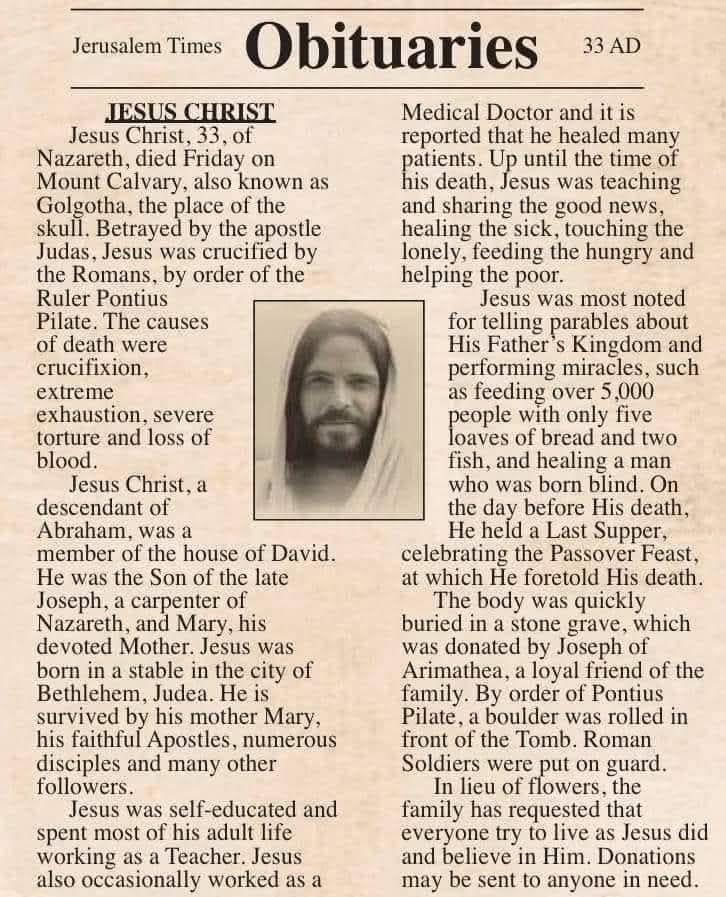
I came across something profound on social media recently—an “obituary” for Jesus. At first glance, it was jarring. An obituary? For the Savior of the world? But as I read on, it became clear: this wasn’t an obituary announcing defeat. It was a proclamation of ultimate victory.
Obituaries typically summarize someone’s life and legacy after death. But Jesus’ story doesn’t end in the tomb. It breaks the mold. His obituary reads like a love letter to humanity, a triumphant declaration that what looked like the end was really just the beginning.
Let’s take a moment to reflect on what such an obituary might say—and what it truly means for us today.
“Jesus Christ of Nazareth, aged 33, passed away on a Friday afternoon around 3 p.m. at a place called Golgotha. He was unjustly tried, brutally beaten, and crucified between two criminals. Cause of death: love.”
That’s how the post began. It hit me deeply. Jesus didn’t just die—He chose death. He gave Himself up willingly (John 10:18), laying down His life not because He had to, but because love compelled Him. The nails didn’t hold Him on the cross—love did.
His surviving family includes… everyone who believes.
That’s the wonder of the Gospel. Because of His death and resurrection, we are no longer orphans but sons and daughters of God (Galatians 4:7). We’re not just mourners at the foot of the cross—we’re beneficiaries of His will, heirs to eternal life.
Jesus was known for His compassion, miracles, teachings, and unwavering obedience to His Father. He healed the sick, raised the dead, and forgave sinners. He preached love, grace, and repentance.
If anyone’s life deserved celebration, it was His. He lived in perfection, yet died in our place. He bore our shame so we could wear His righteousness. That is why this obituary isn’t tragic—it’s triumphant.
Funeral services were held in a borrowed tomb, generously donated by Joseph of Arimathea.
It’s almost humorous to think Jesus only needed a tomb for the weekend. On the third day, the stone rolled away, and the obituary needed an amendment: “He is not here; He has risen!” (Luke 24:6)
Imagine reading an obituary that ends with, “But three days later, He came back to life.” That’s not just good news—it’s the Good News.
What This Means for You
Jesus’ “obituary” reminds us that no matter how dark Friday is, Sunday is always coming. Resurrection follows crucifixion. Life follows death. Hope follows despair.
Whatever seems dead in your life—dreams, relationships, health, purpose—Jesus is the Resurrection and the Life (John 11:25). If the tomb couldn’t hold Him, then your situation isn’t final either.
We serve a Savior who conquered death. That’s not poetic—it’s powerful. It means sin no longer has the last word. Shame doesn’t define you. Failure isn’t your identity. Jesus’ obituary is the proof that your story isn’t over.
A Living Legacy
Obituaries often end with “He will be dearly missed.” But Jesus isn’t missed—He is ever present. He walks with us, comforts us, intercedes for us, and lives within us through the Holy Spirit (John 14:16-17).
His “obituary” is unlike any other because He didn’t stay dead. He lives today, offering forgiveness to the guilty, peace to the anxious, healing to the broken, and hope to the hopeless.
So, the next time you come across that viral post, read it with fresh eyes. Let it remind you that Jesus’ death was the greatest act of love the world has ever known. But even more, remember that His resurrection means you can live fully and freely, too.
Death couldn’t hold Him. And because of that, nothing can hold you. I hope this speaks to you, and I pray you have a blessed day!


 Life-Giving Words of Hope & Encouragement
Leave a reply to Chaplain Jeff Davis Cancel reply