You can feel it in the air lately.
A comment section turns into a courtroom. A conversation turns into a contest. People stop listening and start labeling. The world keeps shouting, “Pick a side,” and before you know it, hearts get hardened, friendships get strained, and whole communities start treating each other like enemies.
Right in the middle of that noise, Jesus whispers something steady and unshakable: Every person you see is made in the image of God. Not some people. Not the people who think like you. Not the people who vote like you. Not the people who look like you. Every person.
That truth does not minimize pain or ignore injustice. It anchors us to the only foundation strong enough to hold a broken world: the love of God, the value of human life, and the call of the Church to be the light.
The Root of Human Value
Human value is not decided by society’s approval, cultural influence, wealth, nationality, success, or status. The worth of a person does not rise or fall based on how many people clap for them, how many people disagree with them, or how much power they hold.
The worth of a person is settled in Genesis.
Genesis 1:27 tells us, “So God created mankind in his own image, in the image of God he created them, male and female he created them.”
That means every life carries divine fingerprints. Every face reflects something of God’s creativity. Every soul has God given dignity.
Psalm 139:14 echoes it: “I praise you because I am fearfully and wonderfully made.”
We do not earn that value. We receive it. It is assigned by the Creator, not negotiated by the crowd.
That is why the statement matters, in a spiritual sense: no lives will truly matter until all lives matter, because the God who made us does not sort human beings into categories of worth. He calls us His image bearers, and He calls us to treat one another accordingly.
Jesus Refused the Labels
When Jesus walked the earth, He stepped over lines that everyone else treated as untouchable boundaries. He spoke with Samaritans. He touched lepers. He ate with sinners. He noticed women others tried to silence. He honored the poor and confronted the proud. He did not reduce people to their reputation, their ethnicity, their past, or their position.
John 3:16 makes it plain: “For God so loved the world that he gave his one and only Son, that whoever believes in him shall not perish but have eternal life.”
God loved the world. Not a slice of it. Not the parts that feel safe. The world.
Jesus did not come to build walls, He came to build a kingdom, and His kingdom is populated by redeemed people from every tribe, tongue, and nation.
Division Is a Strategy of the Enemy
The enemy loves a distracted church.
If he cannot destroy your faith outright, he will try to drain your love. If he cannot silence your worship, he will try to sour your witness. If he cannot stop the Gospel, he will attempt to make believers look nothing like Jesus.
Jesus described the enemy’s agenda in John 10:10: “The thief comes only to steal and kill and destroy; I have come that they may have life, and have it to the full.”
One of the easiest ways to steal life from a community is to plant suspicion. To teach people to assume the worst. To make every disagreement feel like a threat. To turn neighbors into opponents.
Paul speaks directly into this in Galatians 3:28: “There is neither Jew nor Gentile, neither slave nor free, nor is there male and female, for you are all one in Christ Jesus.”
That does not erase our differences, it redeems them. In Christ, our identity becomes deeper than every dividing label. We can disagree without dehumanizing. We can pursue justice without losing love. We can speak truth without poisoning our spirit.
1 John 4:20 confronts us with holy clarity: “Whoever claims to love God yet hates a brother or sister is a liar.”
That verse is not meant to shame you, it is meant to free you. Hatred is a chain. Love is liberty.
The Witness of Dr. King and the Power of Love
Dr. Martin Luther King Jr. understood something profoundly biblical: hate multiplies hate, but love breaks the cycle.
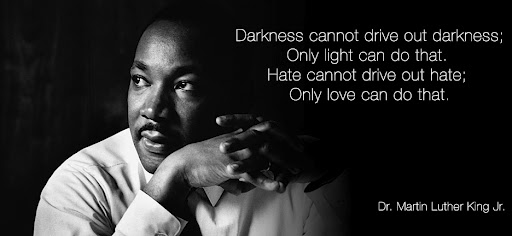
His words ring with Gospel truth: “Darkness cannot drive out darkness; only light can do that. Hate cannot drive out hate; only love can do that.”
He also warned, “Injustice anywhere is a threat to justice everywhere.”
Those statements are not just historical quotes, they are mirrors for the Church. Followers of Jesus are called to be light, to be peacemakers, to be courageous, to be compassionate, and to refuse the cheap substitute of revenge. We do not overcome evil by becoming another version of it. We overcome evil with good, with truth, with courage, and with love that looks like Jesus.
Loving Like Jesus Does Not Mean Looking Away
Real love is not passive. Love does not ignore pain, it moves toward it. Love does not pretend wounds are not real, it helps heal them.
Jesus shows us what this looks like.
In Luke 10:25–37, the Good Samaritan becomes the hero in a story that offended religious pride. The one expected to “pass by” is the one who stops. The one expected to hate is the one who helps. Jesus is teaching us that neighbor love crosses boundaries, because compassion matters more than categories.
In John 8:1–11, religious leaders bring a woman caught in adultery, not to restore her, but to use her as a weapon. Jesus refuses to participate in their cruelty. He says, “Let any one of you who is without sin be the first to throw a stone at her.”
He does not excuse sin, but He also refuses condemnation as entertainment. He protects her dignity, calls her to a new life, and shows us what grace looks like in public.
That is the heart of God: love that tells the truth, and love that refuses to throw stones.
Bridging the Gap Starts Closer Than You Think
The biggest battle is rarely “out there.” It is in here, in the heart, in the tongue, in the assumptions we feed.
Bridging the gap begins with spiritual choices that feel small, but carry enormous power:
- Choose to see people as image bearers before you see them as labels.
- Refuse to make enemies out of those Jesus died to save.
- Listen long enough to honor someone’s humanity.
- Repent quickly when pride turns your opinions into contempt.
- Ask God to give you His eyes, His patience, His courage.
Matthew 5:9 says, “Blessed are the peacemakers, for they will be called children of God.”
Peacemakers are not peacekeepers who avoid hard things. Peacemakers do the hard work of love. They carry the presence of Jesus into tense spaces. They speak with conviction and kindness. They are steady when everyone else is reactive.
James 2:1 reminds us not to show favoritism: “My brothers and sisters, believers in our glorious Lord Jesus Christ must not show favoritism.”
That is not just a verse, it is a lifestyle. The Gospel levels the ground at the foot of the cross. Nobody stands above anyone there. We all come as sinners in need of mercy, and we all leave as people called to extend that mercy.
A Call to Action
Dr. King once asked, “Life’s most persistent and urgent question is, ‘What are you doing for others?’”
That question fits perfectly for disciples of Jesus.
What are we doing for others when conversations get tense? When fear rises? When stereotypes try to settle in? When bitterness feels justified?
God is calling His people to be different, not arrogant, not silent, different. Different in compassion. Different in courage. Different in humility. Different in love.
Mark 12:31 says, “Love your neighbor as yourself.”
Matthew 5:44 says, “Love your enemies and pray for those who persecute you.”
That kind of love is not human strength, it is Holy Spirit power. It is the love of Jesus flowing through surrendered hearts.
In God’s kingdom, all lives matter, because every life reflects His handiwork, and every person is someone Jesus considered worth the cross.
Prayer:
Father, in a world full of noise, anchor my heart in Your love. Forgive me for the times I have judged too quickly, assumed the worst, or let pride harden me toward people You created. Give me the eyes of Jesus, to see image bearers, not labels. Give me the heart of Jesus, to move toward people with compassion, truth, and courage. Teach me to be a peacemaker, steady in Your presence, humble in my posture, and faithful in my witness. Heal what is broken in our communities, expose what is sinful in our systems, soften what is bitter in our hearts, and let Your Church shine like light in the darkness. Help me love my neighbor, love my enemy, and live in a way that proves the Gospel is real. In Jesus’ name, Amen.

 Life-Giving Words of Hope & Encouragement
Leave a comment