Have you ever felt the weight of an unresolved relationship? Maybe it was a harsh word you spoke in frustration, a cold silence that grew too long, or a missed opportunity to show kindness when it mattered most. Those moments linger in the heart. They tug at us late at night or resurface when we see the person across a crowded room.
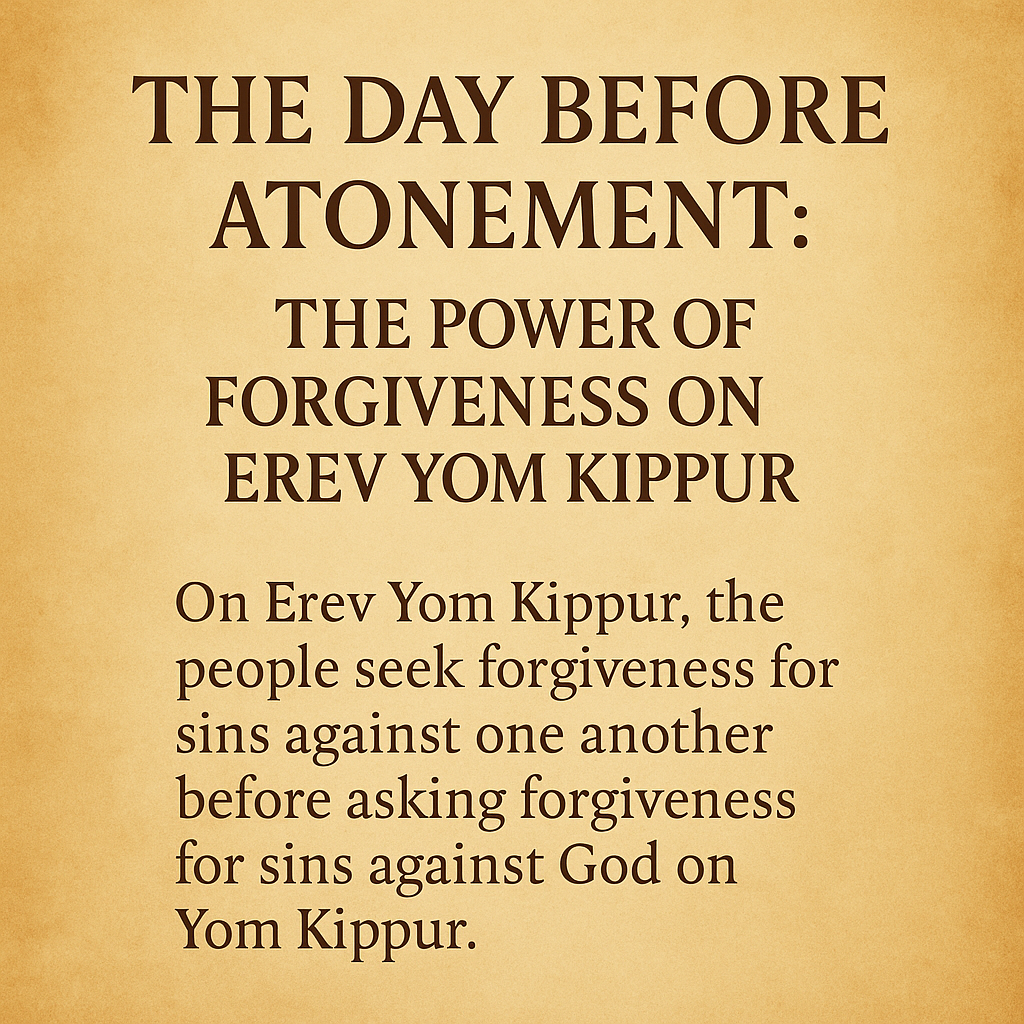
As the sun sets on **Erev Yom Kippur—the eve of the holiest day on the Jewish calendar—**a sacred invitation arises. The air itself seems to hum with anticipation, calling God’s people not only to reflect but also to restore, not only to confess but to reconcile. While Yom Kippur, the Day of Atonement, is centered on seeking God’s forgiveness, Erev Yom Kippur is the doorway to it, urging us to make things right with each other first.
This is not just ancient tradition—it’s a timeless truth. Before we can fully experience God’s cleansing grace, we are invited to extend that grace horizontally, to mend the bonds of love with those around us.
The Courage to Say, “I’m Sorry”
Saying “I’m sorry” is never easy. Pride whispers excuses, fear warns of rejection, and shame convinces us it’s better left unspoken. Yet in Jewish tradition, Erev Yom Kippur is a day of courage—courage to admit our failures, courage to confront our own hearts, and courage to reach out with humility.
This is not about shallow apologies that gloss over real pain. It’s about heartfelt conversations that restore dignity and respect. When we say, “I was wrong. I hurt you. I value you. Please forgive me,” something sacred happens. The walls of bitterness begin to crack, and the Spirit of God breathes healing into wounded places.
In fact, it’s here—in the honesty of reconciliation—that we reflect God’s own heart. He is, after all, the God who runs toward us with mercy, even when we’ve failed Him.
Reconciliation Before Redemption
One of the most striking truths in Jewish teaching is that Yom Kippur itself cannot absolve sins against another person unless we’ve sought their forgiveness. The Talmud (Yoma 85b) states clearly: “For sins between a person and God, Yom Kippur atones. But for sins between one person and another, Yom Kippur does not atone until one appeases the other.”
In other words, we can’t bypass people to get to God. He calls us to reconcile with one another before we approach Him for cleansing.
Jesus affirmed the very same truth in Matthew 5:23–24:
“If you are offering your gift at the altar and there remember that your brother has something against you, leave your gift… First be reconciled to your brother, and then come and offer your gift.”
Reconciliation is not optional. It is the pathway God designed for His people to walk in unity and peace before stepping into His presence.
The Healing Power of Forgiveness
There is a quiet but undeniable power in asking forgiveness—and in granting it. When we finally confess, the burden of guilt begins to lift. When we choose to forgive, the poison of bitterness loses its grip.
Forgiveness doesn’t mean forgetting or minimizing the wrong. Instead, it means releasing the offender into God’s hands. As Paul writes in Colossians 3:13:
“Bear with each other and forgive one another… Forgive as the Lord forgave you.”
That kind of forgiveness liberates both parties. The one who wronged is freed from shame. The one who was wronged is freed from resentment. And in that release, peace flows like a river.
A Time for Spiritual Reset
Erev Yom Kippur is more than a ritual—it’s a reset for the soul. It’s about second chances, fresh starts, and relationships reborn.
The customary greeting, “G’mar Chatimah Tovah” (“May you be sealed for a good year”), carries this hope: that as we reconcile with each other, we prepare ourselves to stand before God with a lighter heart and a renewed spirit.
Think about it—what better gift could we bring to the Lord than a willingness to love others well? Families are restored. Communities are strengthened. God is glorified when His people live in unity.
Extending the Invitation to Us All
Even if you’re not Jewish, there’s a universal lesson here. Forgiveness and reconciliation are not tied to a single tradition—they are God’s desire for all His people.
Paul wrote in Romans 12:18:
“If it is possible, as far as it depends on you, live at peace with everyone.”
We can’t control how others respond. But we can take the first step. We can make the call, send the message, open our arms, and soften our words. And when we do, God meets us in the middle, pouring His grace into our efforts.
Imagine if today became the day you let go of the grudge, spoke the words long delayed, or forgave the one who never even asked. Imagine the freedom that would follow—not just in your heart, but in your walk with God.
A Call to Action
Erev Yom Kippur whispers a call across generations: choose reconciliation. Don’t carry that weight into tomorrow. Don’t wait for a perfect moment that may never come.
God stands ready to forgive, but He also asks us to reflect His love here and now. So let today be the day you break the silence. Let today be the day you extend your hand. Let today be the day peace is restored.
Prayer:
Heavenly Father,
Thank You for being the God of mercy, forgiveness, and new beginnings. As I reflect on the call of Erev Yom Kippur, I ask for courage to face the places where I have fallen short in my relationships. Give me humility to say, “I’m sorry,” and grace to forgive those who have wronged me.
Lord, I don’t want bitterness, pride, or guilt to stand in the way of Your presence. Heal the wounds in my heart and use me as an instrument of reconciliation. Restore what has been broken, strengthen what has grown weak, and let Your love flow through me to others.
Thank You that because of Jesus, I am forgiven, cleansed, and made new. Help me to walk in that same forgiveness toward others. May my life bring glory to You, and may my relationships reflect Your grace.
In Jesus’ name, Amen.

 Life-Giving Words of Hope & Encouragement
Leave a comment