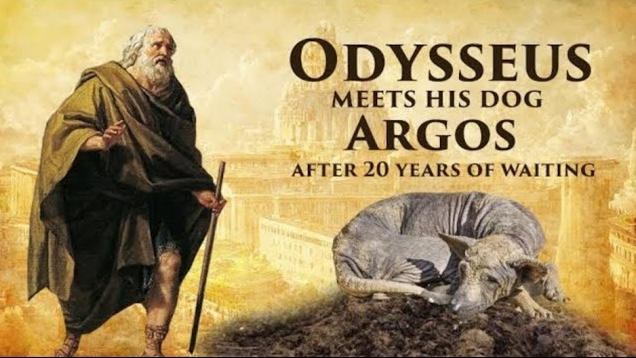
Loyalty is a rare and precious virtue, often revealed in the quietest and most unexpected moments. One of the most touching portrayals of unwavering devotion in literature comes from The Odyssey, Homer’s eighth-century BC epic. It tells the tale of Odysseus, the great warrior-king of Ithaca, who after 20 years of war and wandering, finally returns home in disguise. Though no one recognizes him—neither his family, friends, nor servants—one soul does: his faithful dog, Argos.
Argos, once a strong and noble hunting dog, has been neglected in his master’s long absence. Now weak and flea-ridden, he lies on a pile of filth, seemingly abandoned by the world. Yet the moment Odysseus approaches, though still disguised, Argos’ ears twitch, his tail wags softly, and his dim eyes light up with recognition. The old dog—having waited two long decades for this moment—finally sees his master again. With one last sigh of peace, he lets go of life, having fulfilled his purpose: to wait for the one he loved most.
This moment from The Odyssey (Book 17) remains one of the most moving passages in literature. It is not a tale of heroism, conquest, or gods and monsters—it is a simple, heartbreaking testament to devotion. Argos’ loyalty endures despite years of hardship, echoing a truth that transcends time: love never forgets.
Argos’ unwavering devotion closely parallels one of the most powerful parables in the Bible: the story of the Prodigal Son (Luke 15:11-32). While the contexts are different, the themes of patient waiting, unwavering love, and joyful recognition are strikingly similar.
In the biblical story, a younger son demands his inheritance and squanders it in reckless living. When famine strikes and he is left destitute, he finally decides to return home, expecting rejection but hoping for mere survival as a servant. However, the moment he appears in the distance, his father—who had been watching and waiting for his return—recognizes him instantly. Overcome with love, the father runs to embrace his lost son, celebrating his return rather than condemning him.
Like Argos, the father had waited for years, never ceasing to hope, never ceasing to love. Just as Argos recognized Odysseus through his disguise, the father recognized his son despite the wear of time and hardship. And just as Argos’ joy was his final moment of peace, the father’s joy overflowed into a great feast, a moment of ultimate reconciliation.
Both stories remind us that true love never dies. Whether in the form of a faithful dog waiting for his master or a loving father waiting for his lost child, devotion endures through time, trials, and suffering.
Recognition is a powerful theme in both The Odyssey and the Bible. Argos, though weak and neglected, still possesses a heart that sees clearly. His sight—clouded with age—is still sharper than those of Odysseus’ own people, who fail to recognize their king. This mirrors the way spiritual blindness often prevents people from recognizing truth, even when it stands before them.
In the Bible, Jesus is often unrecognized by those around Him, despite being the promised Messiah (John 1:10-11). The Prodigal Son’s older brother also fails to understand the true nature of his father’s love, missing the significance of grace and reconciliation. True recognition requires more than sight—it requires the heart to see what truly matters.
Argos saw beyond Odysseus’ disguise, just as the Prodigal Son’s father saw beyond his son’s failures. Both moments reveal that love does not depend on appearances, status, or time. Love knows. Love waits. Love recognizes.
These stories teach us profound lessons about loyalty, patience, and love:
- Love Waits – Whether it’s Argos patiently waiting for Odysseus or the father watching for his son’s return, true love endures through the years. It does not give up, even when hope seems lost. (2 Peter 3:9)
- Love Recognizes – Argos saw through Odysseus’ disguise, just as the father saw his son from afar. Love recognizes the heart, not just the outward appearance. (1 Samuel 16:7)
- Love Rejoices – Argos’ last moment was filled with joy, just as the father in the Prodigal Son story celebrated his son’s return. Love does not count lost time—it celebrates reunion. (Luke 15:32)
- Love Is Selfless – Argos waited for Odysseus with no expectation of reward, and the father welcomed his son without conditions. True love gives freely. (1 Corinthians 13:4-7)
- Love Never Forgets – Whether in a faithful dog’s last breath or a father’s embrace, love remains constant through absence and hardship. (Isaiah 49:15)
Both The Odyssey and the Bible remind us of a truth written deep within the human heart: we long to be loved with a love that never gives up. Argos’ devotion mirrors the kind of faithfulness we all desire—to love and be loved in return. And in the Prodigal Son’s father, we see the ultimate picture of grace: a love that is ever watchful, ever forgiving, ever waiting for us to come home.
In the end, Argos’ final act of loyalty is more than just a moving scene in an ancient epic—it is a reminder of the divine love that waits for each of us, unwavering and unshaken, through all our wandering, in the loving arms of our Savior. I hope this speaks to you, and I pray you have a blessed day!

 Life-Giving Words of Hope & Encouragement
Leave a comment