Proverbs 16:24 says, “Kind words are like honey—sweet to the soul and healthy for the body.” Our words have the power to lift people and help them overcome challenges. When you tell someone, “I love you. I’m proud of you. You did great on that project,” you’re not just being kind; those are healing words.
We never know what someone is going through. They might appear happy on the outside, but inside, they could struggle, feel lonely, or have lost hope. Many people carry emotional wounds from the past. A simple word of encouragement, a thoughtful compliment, or letting them know that you believe in them can make a huge difference. What might seem insignificant to you can help heal their wounds, lift their spirits, and give them the confidence to believe in themselves. In today’s society, where negativity is rampant on the internet and social media, it’s crucial to counteract it with kindness.
Jesus said that people would recognize that we are His disciples by the love we show others. You have the power to lift someone and to inspire them to pursue their dreams. When someone does something good for me, I am grateful. But when someone does something good for my children, when they go out of their way to help them in a time of need, as a parent, there’s nothing I won’t do for them.
That’s how God works when you go out of your way to bless one of His children. When you take the time to encourage a co-worker who’s feeling down, visit an unwell friend, or call a relative to say you love them, you’re taking care of God’s children. These acts are the seeds you’re sowing. Take a look around at the people in your life. They’re not there by accident. They need your encouragement, affirmation, and belief in them.
Scripture says, “A gentle tongue brings healing.” When we think of healing, we often think of praying for people, and that’s one way. But our words have healing power. We are healers when we are kind and encouraging. We might not think much of it, but to the other person, it breathes life into their spirit.
If you saw someone who was sick, fighting an illness, and you had the cure, the medicine that would help them get well, you would quickly get it to them. You’d go over as fast as you could and say, “Here, take this right now. I don’t want you to suffer anymore.” That’s the way you need to see your compliments, kind words, and encouragement. It’s the healing that people need. Don’t withhold it. Don’t try to reason it out. You don’t know what’s happening on the inside. I’ve learned that everyone is going through something. Even the people who look like they have it all together don’t have it all together. There’s always something that people are dealing with.
Proverbs 18 says, “Our words can be life-giving water.” Most people I encounter are thirsty, have gone through heartaches, and have been beaten down in life. We have something to offer them. Our words can help heal their hurts. Be aware of who’s in your life, be sensitive to what you’re feeling, and take time to let people know that you care. Nobody comes into your life by accident, and nothing is more rewarding than helping someone else. We are never more like Jesus than when we help the hurting.
Why not start by focusing on your own family? When was the last time you told the people in your life, “I love you, I’m glad you’re mine?” Don’t let a stranger compliment your spouse more than you do. Don’t let a coach, a teacher, or a friend make your children feel more special than you do. Bless your children with your words every day. Tell them how proud you are of them. Share their interests and help them see what they can become. Call out their potential for greatness. Remind them they’re made in the image of almighty God, full of potential, and meant to go further than you.
People in your life need healing, blessings, and encouragement. Your kind words can be the life-giving water that quenches their thirst. You can remind them what God says about them and break the chains that bind them. Look around and ask yourself: “Who can I bless? Who can I help heal? Who can I help achieve their destiny?”
This is what King David did for Mephibosheth. He was the grandson of King Saul and the son of Jonathan, David’s best friend. Mephibosheth was born into royalty and destined to take the throne one day. His future looked bright, but at the age of 5, everything changed. Both his father and grandfather were killed in a battle on the same day. After the enemy army finished off King Saul and his men, they turned toward the city to wipe out all of Saul’s family.
When the news reached home, Mephibosheth’s nurse grabbed him as fast as she could and took off running, trying to hide him to spare his life. However, she lost her footing and fell as she descended some stairs. Mephibosheth hit the ground so hard that he broke both legs and became crippled. He would never walk again.
Sometimes in life, well-meaning people can hurt us. The nurse tried to do the right thing; she had good intentions, but her mistake cost him his mobility. Life is not always fair. Like Mephibosheth, somebody may have put you at a disadvantage. They didn’t mean to; they would take it back if they could, but they tripped, and now you struggle with addictions, bad habits, and things that were passed down. Or they weren’t there to protect you when you needed them the most. Now, you struggle with your self-worth and your sense of value.
Mephibosheth became lame in both of his feet, and if we’re honest, we all have some area of lameness to overcome that is holding us back. It’s easy to make excuses, especially when it wasn’t our fault. We can blame the past, blame how we were raised, blame what we didn’t get, but all making excuses will do is keep you from your destiny.
Many people spend their lives dwelling on past hurts and disappointments. Mephibosheth’s life was turned upside down in an instant. Not only did he lose his father and grandfather, but he also became crippled and unable to walk. He ended up living in exile in Lo-Debar, one of the poorest and most run-down cities. “Lo-Debar” means “without pasture,” and it was a barren wasteland.
Mephibosheth had no family, and nobody to help him, and it looked like that was his lot in life. However, years later, King David was on the throne. One night in the palace, David began thinking about all God had done, reminiscing about old times, and he remembered his best friend, Jonathan. All of a sudden, he had a desire to be good to Jonathan’s family. He asked his staff if anyone was still alive from the house of Saul. They said, “The only one we think is alive is Jonathan’s youngest son. His name is Mephibosheth, but he’s crippled, and he’s living in Lo-Debar.” David said, “Go get him right now and bring him to the palace.”
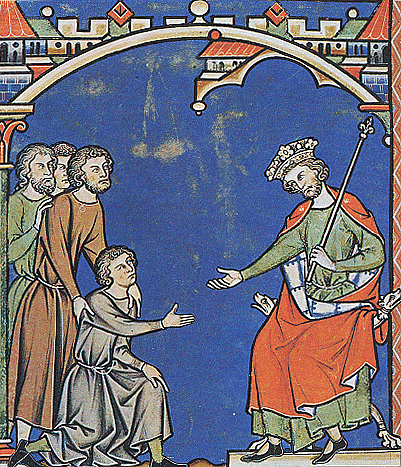
I’m sure he was terrified when Mephibosheth finally arrived at the palace. He had heard how his grandfather, King Saul, repeatedly tried to kill David. When David walked in, Mephibosheth fell flat on his face, laying prostrate to show respect.
David sees Mephibosheth trembling and reassures him, saying, “Mephibosheth, don’t be afraid. I didn’t come to harm you. I brought you here to show you kindness and restore what belonged to your father, Jonathan, and your grandfather, King Saul. I will return all the land to you, have servants farm it, and generate income for you.
That’s the kind of God we serve. Sometimes, when we hear that the King is looking for us, we think, “Man, I’m hiding. I don’t want God to find me. I’ve got a lot of weaknesses. I’m not where I should be in life. I feel bad enough about myself; I don’t need someone condemning me.” But God desires to restore you, giving back all that rightfully belongs to you: joy, peace, honor, freedom, abundance, and victory.
The Psalmist said, “God heals the broken-hearted; he binds up their wounds.” Well, Jeff, this sounds good, but Mephibosheth was crippled because somebody else tripped. That’s why God restored him. I’m crippled because of my own poor choices. I blew it. I can’t expect God to be good to me. Praise God, we don’t get what we deserve; that is what mercy is all about! When we go off course, God doesn’t write us off or disqualify us. On the contrary, as the Good Shepherd, He comes looking for us.
Perhaps today, you feel like you’ve gone too far, made too many mistakes, and been through too much. But can I tell you something? The King is looking for you, not to condemn you, but to restore, bless, and propel you into your purpose. Life may have thrown you some curveballs, and you might not be where you thought you’d be. However, remember that your location doesn’t change your identity. No matter where you are, you’re still a child of the Most High God. There’s a seat for you at the King’s table. The wonderful thing about God is that even when you can’t get there alone, God will have somebody carry you, just like when David decided to be good to Mephibosheth. I hope that speaks to you, and I pray you have a blessed day!

 Life-Giving Words of Hope & Encouragement
Leave a comment